
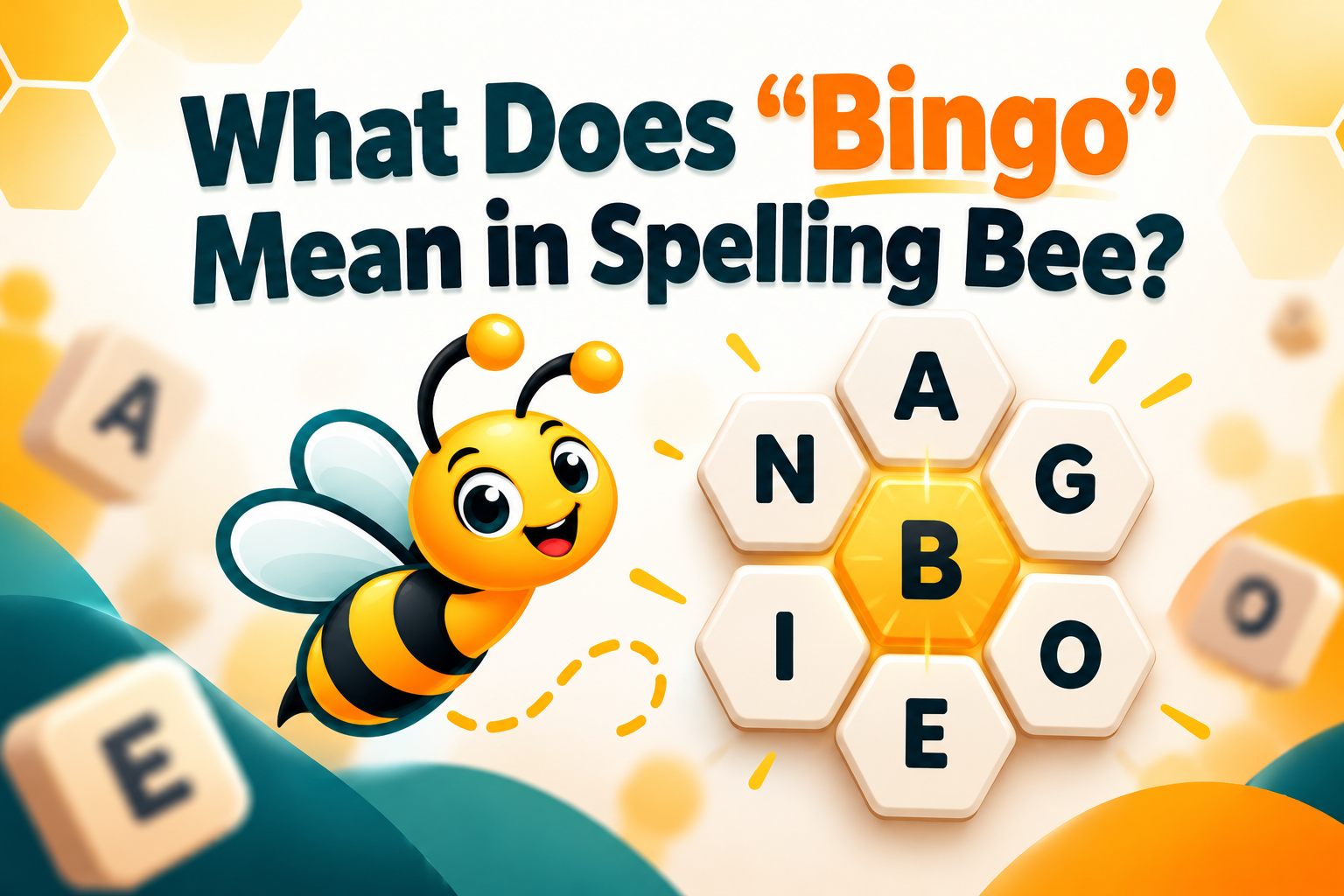
The phrase “what does bingo mean in spelling bee” usually refers to a special achievement in the popular word game Spelling Bee. A player gets a bingo when they find every possible word that can be made from the seven letters provided for that day. The center letter must be used in every valid word, while the other letters may be used as needed and repeated. Reaching bingo is considered a major accomplishment because it means the player has discovered the complete set of accepted words. It requires vocabulary knowledge, careful pattern recognition, patience, and the ability to keep searching after finding the obvious answers. This guide explains exactly what bingo means, how the scoring works, why it matters, how to improve your chances, and which mistakes commonly prevent players from reaching it.
What Bingo Means In Spelling Bee
In Spelling Bee, bingo means finding all the accepted words that can be created from the seven-letter honeycomb. One letter is placed in the center and is mandatory. The remaining six letters surround it, and every submitted word must contain the center letter at least once.
A bingo is not simply a high score or a long word. It represents complete word discovery for that puzzle. If the game contains 40 possible words and you find all 40, you have achieved bingo. The game may recognize this accomplishment with a special message, badge, or visual celebration.
1. The Seven Letters
Each puzzle uses seven letters, usually arranged in a honeycomb shape. One letter sits in the center, and six letters appear around it. You may use the letters more than once, but you cannot use any letter outside the displayed set.
The center letter acts as the foundation of every answer. Even if a word can be spelled using only the outer letters, it will not count unless the center letter appears somewhere in the word.
2. The Mandatory Center Letter
The central letter is the most important letter in the puzzle because every valid word must include it. This rule limits the number of possible answers but also creates useful word patterns.
When looking for words, players often begin by combining the center letter with common prefixes, suffixes, and word endings. For example, if the center is A, endings such as “-ate,” “-al,” “-ing,” and “-er” may reveal several possible answers.
3. Accepted Words Only
Bingo depends on the official word list used by the game. Not every word found in a dictionary will necessarily be accepted. Proper nouns, abbreviations, hyphenated terms, and some uncommon forms may be excluded.
The game also accepts certain unusual words that many players do not use in everyday conversation. This means that reaching bingo involves learning the game’s vocabulary style as well as relying on normal spelling knowledge.
4. Complete Puzzle Discovery
A player can achieve a high rank without finding every answer, but bingo requires full completion. The exact number of words varies from puzzle to puzzle because each letter group creates a different collection of possible words.
The final few words are often the hardest. They may be rare terms, plural forms, repeated-letter words, or words hidden behind an unfamiliar prefix. Finishing the puzzle requires persistence and systematic searching.
5. Repeated Letters Are Allowed
Spelling Bee allows a letter to be used more than once within a word. This rule makes it possible to create words with doubled letters, repeated vowels, or longer combinations that would not be possible in a traditional letter-tile game.
For example, a letter may appear twice in a word even though it appears only once in the honeycomb. Remembering this rule is essential because many players reject correct answers simply because they think each letter can be used only once.
6. Word Length Requirements
Most versions of Spelling Bee require words to contain at least four letters. Shorter combinations are not accepted, even when they use the center letter and otherwise follow the rules.
Longer words usually earn more points, but length alone does not determine bingo. A complete puzzle may include many short words that are easy to overlook, so players must search for both common four-letter answers and longer terms.
How Bingo Scoring Works
Scoring helps explain why bingo is such an important goal. Players earn points for each accepted word, with longer words generally receiving more points. Words containing all seven letters are often called pangrams and receive a significant bonus.
A bingo means that the player has found every possible word, not necessarily that they have earned the highest possible score through a particular strategy. If the puzzle includes one or more pangrams, finding them helps increase the score, but all remaining words must also be discovered to complete the puzzle.
1. Four-Letter Words
Four-letter words generally receive the smallest point value. They are often easy to overlook because players naturally focus on longer, more impressive words.
However, these short answers are important when pursuing bingo. A single missing four-letter word can prevent a player from completing the entire puzzle, even if every long word has already been found.
2. Longer Words
Words with five or more letters usually earn additional points based on their length. This rewards players who notice extended forms, compound words, and words that can be built with common suffixes.
Long words are also useful clues. When you discover one word, examine its structure for shorter related words. A longer answer may suggest a root, ending, or variation that leads to several more accepted entries.
3. Pangram Bonuses
A pangram uses all seven letters at least once. These words are especially valuable because they usually receive a bonus in addition to their normal length-based points.
Some puzzles have one pangram, while others have several. Finding a pangram can reveal how the letters work together and may expose word families that help you discover other answers.
4. Ranking Levels
Spelling Bee commonly uses progress levels that indicate how close a player is to the puzzle’s maximum score. These levels may have names such as Good Start, Moving Up, Great, Amazing, or Genius.
Reaching Genius is impressive, but it does not always mean the player has achieved bingo. A person may reach the top ranking while still missing a few obscure words. Bingo represents completion rather than a particular progress label.
5. Total Possible Points
The total possible score depends on the puzzle’s word list and the number of pangrams. Since each letter arrangement produces different words, there is no single universal score required for bingo.
Players who want to measure progress should focus on the percentage of possible words found, the number of missed answers, and whether all pangrams have been discovered. These measures provide a clearer picture than rank alone.
6. Why Score And Bingo Differ
Score measures the value of the words you found. Bingo measures whether you found every available word. A player can earn many points from long answers but still miss several short words.
This difference explains why a high score does not automatically mean a completed puzzle. If your goal is bingo, you must continue searching after reaching a satisfying rank and review the letter combinations you have not yet explored.
Why Players Aim For Bingo
Bingo is appealing because it turns a casual word game into a complete problem-solving challenge. It rewards both language ability and methodical thinking. The goal is not only to find words quickly but also to uncover the structure behind the puzzle.
Many players enjoy bingo because it provides a clear finish line. Instead of stopping when the score feels high enough, they have a specific objective: find every valid answer.
1. It Demonstrates Complete Mastery
Finding all the words shows that a player has explored the puzzle thoroughly. It demonstrates knowledge of vocabulary, word formation, spelling patterns, and the game’s accepted word rules.
Bingo does not mean someone knows every word in the English language. It means they successfully solved one carefully defined letter set, often by combining knowledge with disciplined searching.
2. It Encourages Persistence
The easiest words usually appear early, while the final answers require patience. Players must continue working even when progress slows down and familiar combinations stop producing new results.
That persistence is part of the challenge. The satisfaction of bingo often comes from finding an answer that remained hidden after several rounds of searching.
3. It Improves Pattern Recognition
Repeated play helps users notice common beginnings and endings. They become more familiar with patterns such as “re-,” “un-,” “-ing,” “-ed,” “-er,” “-ness,” and “-tion.”
This pattern awareness makes future puzzles easier. Players begin to see possible word families instead of treating every answer as an isolated discovery.
4. It Builds Vocabulary
Spelling Bee introduces players to uncommon words, regional terms, technical vocabulary, and inflected forms. Even when a word is unfamiliar, seeing it repeatedly can improve recognition and spelling.
A useful habit is to remember the word’s root and meaning rather than memorizing it as a random sequence of letters. This makes the new vocabulary more transferable.
5. It Creates A Daily Challenge
The daily format encourages a regular mental exercise. Players can spend a few minutes searching casually or devote much longer to reaching bingo.
Because the letter set changes, each puzzle presents a fresh challenge. The game remains interesting even after a player becomes experienced because familiar strategies must be adapted to new combinations.
6. It Makes Progress Measurable
Players can compare their results across days by looking at time, score, rank, and completion status. This creates a simple way to identify improvement.
For example, someone who once stopped at Good Start may gradually reach Genius or bingo more often. The measurable progress can make vocabulary practice feel rewarding rather than repetitive.
How To Find A Bingo Step By Step
Reaching bingo becomes more manageable when you use a consistent process. Random guessing may produce a few words, but systematic searching reduces the chance of missing a simple answer.
Start broadly, then organize the letters into patterns. Keep revisiting the puzzle after discovering new roots or endings because one word often suggests another.
1. Scan For Obvious Words
Begin with common words that use the center letter. Look for familiar nouns, verbs, adjectives, and everyday forms.
This first pass creates momentum and helps reveal which letter combinations appear productive. Do not spend too long on one difficult word before checking the rest of the available letters.
2. Search By Starting Letter
Take each honeycomb letter and combine it with the center letter. Ask whether the pair can begin a common word or form a familiar prefix.
Working letter by letter is more reliable than waiting for words to appear randomly. It also helps identify letters that have produced very few answers and deserve extra attention.
3. Check Common Endings
After finding a root, test endings such as “-s,” “-ed,” “-er,” “-ing,” and “-ly” when they are grammatically possible. Some endings may be accepted while others may not, so use the game’s response as feedback.
This method can quickly expand a small group of words into a larger word family. Be careful, however, not to assume that every grammatical variation is included.
4. Look For Repeated Letters
Try doubling vowels and consonants where English spelling allows it. Repeated letters are easy to forget because the honeycomb displays each letter only once.
Words with repeated letters may be uncommon or longer than the answers you initially notice. Testing them is particularly important near the end of a puzzle.
5. Search For Word Families
When you find a word such as a verb, consider related nouns, adjectives, plurals, or inflected forms. A shared root may produce several answers.
Do not assume every related form is valid, but use the connection as a search guide. Word families often reveal missing answers more efficiently than completely independent guessing.
6. Hunt For Pangrams
Try to combine all seven letters into a single word. Pangrams may be long and unusual, but they can provide valuable clues about the puzzle’s vocabulary.
Once you find one, examine its parts. The pangram may contain a root or ending that points toward several shorter answers you have not yet considered.
7. Review Systematically
When you believe you are nearly finished, inspect each starting letter and each major ending again. Make a mental or written grid of the combinations you have tested.
This final review is where many players discover the last missing word. A structured check is more effective than repeatedly typing the same familiar guesses.
Common Bingo Mistakes To Avoid
Even experienced players can miss bingo because of habits that limit their search. Understanding these mistakes makes it easier to adjust your approach and finish more puzzles.
1. Stopping At Genius
Reaching the highest visible rank can feel like completion, but it is not always bingo. Some puzzles contain additional words beyond the points needed for the top ranking.
If you want a complete solution, continue searching until the game confirms that all possible words have been found or until your word count matches the puzzle’s total.
2. Ignoring Four-Letter Words
Players often focus on long answers because they are more memorable and valuable. This can leave several short words undiscovered.
Always return to the minimum word length during your final review. A small, common-looking word may be the exact answer preventing bingo.
3. Rejecting Unfamiliar Words
Some valid entries may look strange because they are old, technical, regional, or rarely used in conversation. Rejecting a word simply because it feels unfamiliar can narrow your search too much.
When the letter pattern seems plausible, test it. The game’s response will tell you whether the word belongs to the accepted list.
4. Forgetting Repetition
A letter can be used more than once, and overlooking this rule removes many possible answers. Players may see only combinations with unique letters and miss words containing repeated vowels or consonants.
Make repeated-letter searches part of your normal routine, especially when the center letter is a common vowel or consonant.
5. Assuming Every Form Counts
The opposite mistake is believing that every plural, tense, or derivative must be accepted. Spelling Bee uses a defined word list, so logical forms can still be rejected.
Treat related words as possibilities rather than guarantees. Learn from rejected attempts and focus on patterns that the puzzle consistently accepts.
6. Searching Without A System
Random guessing may work at the beginning but becomes inefficient later. Without a method, players repeatedly test familiar combinations while ignoring less obvious letters.
Use starting-letter scans, word families, endings, and pangram searches in a deliberate order. A system reduces repetition and makes gaps easier to identify.
Best Practices For Reaching Bingo
The most effective players combine broad vocabulary knowledge with a repeatable search routine. These practices can improve both speed and accuracy without making the game feel mechanical.
1. Begin With The Center Letter
Treat the center letter as the anchor for every search. Build possible words around it instead of trying to form combinations that may not satisfy the main rule.
This keeps your guesses relevant and reduces wasted effort. It also helps you notice common patterns in which the center letter appears at the beginning, middle, or end.
2. Use A Mental Word Grid
Imagine each outer letter as a column and record the words you find under it. You do not need a physical notebook, but a mental grid can reveal which starting letters have received little attention.
This approach is especially useful when you have already found many answers. It turns a vague feeling of being stuck into a clear search target.
3. Explore Both Directions
Do not search only for words that begin with a particular letter. The center letter may appear at the beginning, middle, or end, and outer letters can form many different arrangements.
Consider prefixes, suffixes, and internal letter patterns. Exploring different positions gives you a wider range of possible answers.
4. Think In Roots
Instead of treating every word as unrelated, identify roots and extensions. A root may lead to a plural, a verb form, an adjective, or a longer derived word.
This method improves efficiency because one discovery generates several new questions. It also helps you remember unusual words after the puzzle is complete.
5. Recheck After A Break
Taking a short break can make hidden patterns easier to see. When you return, your mind is less attached to the same guesses and may notice a combination that previously seemed invisible.
A fresh look is particularly helpful when you are missing only a few words. The solution may be simple but obscured by mental fatigue.
6. Study Accepted Vocabulary
Over time, notice the types of words the game accepts and rejects. This includes common suffixes, unusual nouns, verb forms, and words with repeated letters.
The goal is not to memorize every possible answer. It is to develop a better sense of which word patterns are worth testing.
7. Use Hints Carefully
If the version of the game offers hints, use them as guidance rather than as a replacement for searching. A hint can show how many words begin with a particular letter or reveal progress toward a word family.
Used thoughtfully, hints teach you where your search is incomplete. They can support learning while preserving much of the puzzle’s challenge.
Practical Examples Of Bingo Searches
Examples show how a player can move from a few obvious words toward a complete puzzle. The exact letters change each day, but the reasoning process remains similar.
1. Finding A Basic Word Family
Suppose the center letter can support a common root such as “play.” After finding the root, consider plural forms, longer derivatives, and words that use the same central pattern.
The important lesson is not the specific word. It is the habit of using one accepted answer as a clue for related possibilities without assuming that every possible variation will count.
2. Testing Prefixes
If several letters can follow a familiar prefix such as “re,” search for words beginning with that pattern. Then check whether the center letter appears in the required position.
Prefixes can produce several answers quickly, but they should be tested against the puzzle’s actual letter set. A familiar prefix is useful only when all letters remain available.
3. Looking For Suffixes
A word ending such as “-ing,” “-er,” or “-ed” can reveal hidden answers. Start with a possible root and ask whether the ending creates a recognized word using the center letter.
Suffix searches are particularly effective when the puzzle includes a productive verb or adjective pattern. They can also expose longer answers after a shorter word is found.
4. Searching Repeated Vowels
If the puzzle contains a strong vowel pattern, test words with repeated vowel sounds or doubled vowels. Players often avoid these because the letters appear only once in the honeycomb.
Repeated vowels can create unusual but valid terms. They are worth checking when the obvious combinations have been exhausted.
5. Building Toward A Pangram
After finding words that use most of the letters, compare their structures. A common root may be capable of accepting the remaining letter and forming a pangram.
Pangram searches are easier when you examine long words already discovered. Their letter combinations can act as a framework for testing the final unused letter.
6. Reviewing A Nearly Complete Puzzle
If only two or three words remain, stop making random guesses. Review every starting letter, check common endings, and test repeated letters.
The final answers are often located in categories you have neglected. A deliberate review is more likely to succeed than entering increasingly unusual combinations without a plan.
Frequently Asked Questions
1. Does Bingo Mean I Found The Highest Score?
Not necessarily. Bingo means you found every accepted word in the puzzle. Reaching the highest ranking means you earned enough points to reach the game’s top progress level, but additional words may still remain. A player can achieve the highest rank without completing the full word list.
2. How Many Words Are Needed For Bingo?
There is no fixed number. The required total changes with every letter arrangement because different honeycomb sets create different word lists. To achieve bingo, you must find all valid words recognized by that particular puzzle, regardless of whether the total is small or large.
3. Can A Four-Letter Word Prevent Bingo?
Yes. Four-letter words usually earn fewer points, but they still count as possible answers. Missing one short word means the puzzle is incomplete, even if you have found all pangrams and reached the highest score ranking. Always review the shortest accepted word length.
4. Are Pangrams The Same As Bingo?
No. A pangram is a word that uses all seven letters at least once. Bingo means finding every possible word in the puzzle. A puzzle may contain several pangrams, but discovering them does not guarantee that you have found all shorter, longer, or less familiar answers.
5. Can Letters Be Repeated In Spelling Bee?
Yes. Letters may be used repeatedly within a word. This rule allows words with doubled letters, repeated vowels, and longer combinations. Remembering repetition is important because many players miss valid answers when they assume each displayed letter can be used only once.
6. Why Are Some Normal Words Rejected?
The game uses a specific official word list, which may exclude proper nouns, abbreviations, offensive terms, hyphenated forms, or certain grammatical variations. It may also accept uncommon words that are unfamiliar to you. A rejected word does not necessarily mean it is not a real word; it may simply fall outside the game’s vocabulary rules.
Conclusion
In Spelling Bee, bingo means finding every accepted word that can be made from the seven displayed letters while using the center letter in each answer. It is different from earning a high score, reaching the Genius level, or discovering a pangram. Bingo represents complete puzzle completion and requires careful searching, vocabulary knowledge, and persistence.
The best way to reach bingo is to work systematically. Begin with the center letter, explore common roots and endings, check repeated letters, search for pangrams, and review overlooked short words before stopping. With practice, you will become better at recognizing patterns and turning a few obvious answers into a complete solution.