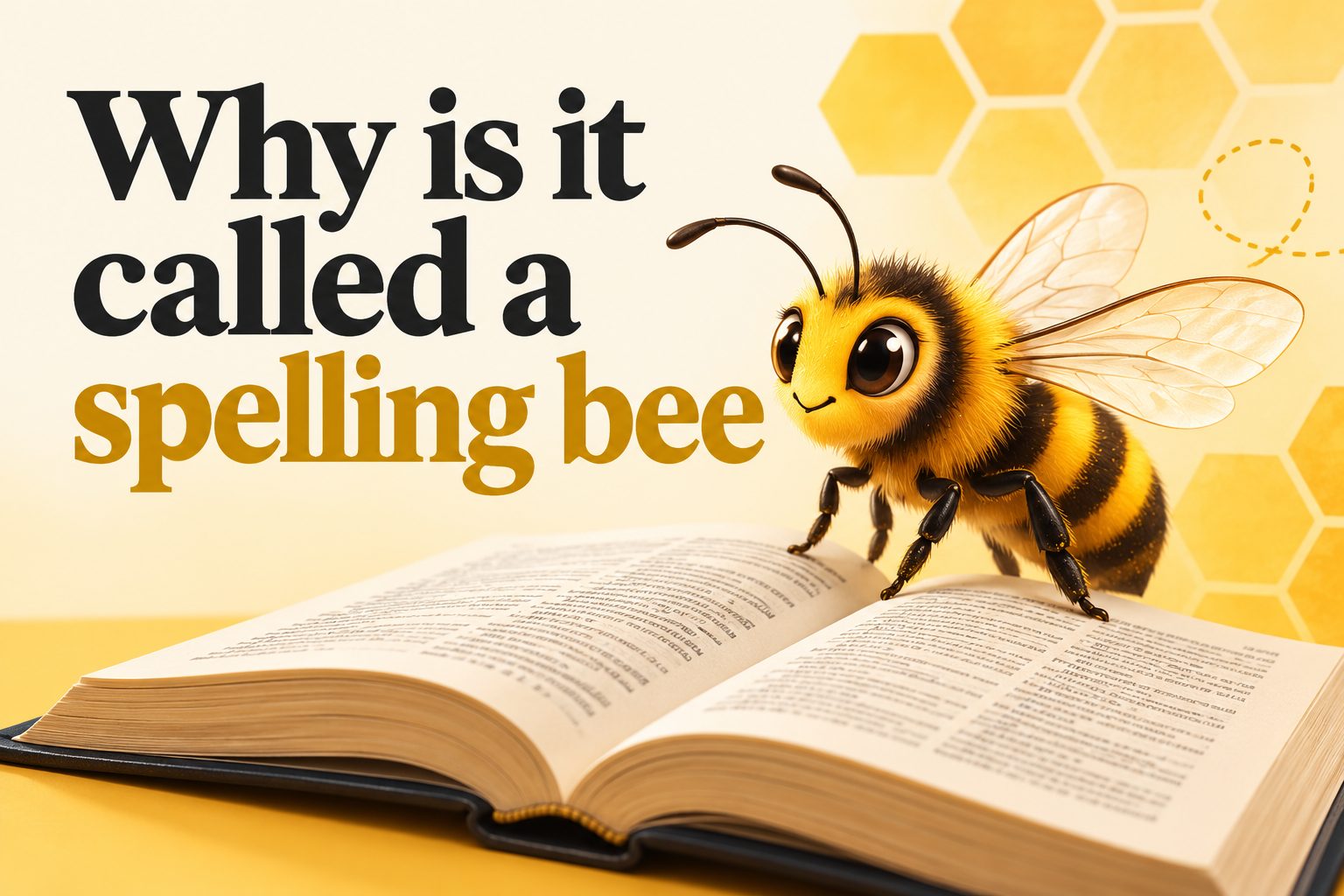
The question “why is it called a spelling bee?” has a surprisingly interesting answer. The word “bee” does not refer to the buzzing insect, even though bees are now commonly used as mascots and decorations at spelling competitions. In this context, a bee is a social gathering where people work together or take part in the same activity. Communities once held quilting bees, husking bees, and other cooperative events. A spelling bee followed the same naming pattern: it was a gathering organized around spelling. Over time, the term came to describe the familiar contest in which participants spell words aloud, usually one at a time. The name connects modern school competitions with an older tradition of community participation, shared learning, and friendly rivalry. Exploring its origin also reveals how spelling bees developed, why they became important in education, how competitions work, and what participants can gain from preparing for them.
What the Name Spelling Bee Means
The meaning of “spelling bee” becomes clearer when the two words are considered separately. “Spelling” identifies the activity, while “bee” describes the kind of gathering in which that activity takes place.
In older English usage, a bee could mean a meeting where neighbors gathered for a shared task. The work might be practical, educational, or social. People attended not only to finish a job but also to exchange knowledge, strengthen relationships, and enjoy one another’s company.
A spelling bee originally fit this community-based idea. Participants gathered to demonstrate their spelling knowledge, learn words, and compete in front of others. The event combined education with public entertainment.
The term eventually became so familiar that its older meaning was largely forgotten. Many people now associate “bee” almost entirely with the insect or assume that the contest received its name because contestants are busy like bees. That explanation is memorable, but it is not considered the primary historical origin.
Where the Word Bee Came From
The exact linguistic history of “bee” in the sense of a gathering is not completely settled. Language scholars have proposed several explanations, and surviving written evidence does not provide one universally accepted answer.
One theory connects the word with older forms related to help, service, or collective labor. This interpretation makes sense because many early bees involved neighbors helping one another with tasks that were easier to complete as a group.
Another theory suggests that the term may have been influenced by the behavior of actual bees. A hive represents organized, cooperative activity, so speakers may have found the image appropriate for a busy gathering. However, that association does not prove that the insect directly supplied the name.
There is also a proposed connection with dialect words referring to favors or assistance. Because spoken regional language often developed before it appeared in print, tracing one definite path is difficult.
The safest conclusion is that “bee” had a recognized historical meaning as a communal gathering. Whether that meaning arose independently or was influenced by the insect remains open to debate.
Other Community Bees in History
Spelling bees were part of a broader naming tradition. Earlier communities used the word “bee” for many gatherings centered on shared work.
A quilting bee brought people together to sew sections of a quilt. Although the work had a practical purpose, the occasion also created time for conversation, storytelling, and social connection.
A husking bee involved removing husks from harvested corn. A large group could complete the work faster than one household working alone, especially during a busy agricultural season.
Communities also organized sewing bees, apple bees, logging bees, and raising bees. At a raising bee, neighbors helped construct or raise the frame of a building.
These events show that a bee was more than a contest. It was a cooperative social occasion built around a specific activity. A spelling bee differed because participants displayed individual knowledge, but it preserved the central idea of people gathering for a common purpose.
How Spelling Bees Developed
Spelling practice became especially important as formal education expanded and printed schoolbooks became more widely available. Teachers needed practical ways to help students learn standard written English.
Early classroom spelling activities were not always organized like modern elimination contests. Students might recite words from memory, spell in teams, or stand in lines while a teacher tested them.
Popular spelling books gave schools a more consistent body of words to teach. In the United States, Noah Webster’s spelling books had a major influence on language instruction. They helped standardize common spellings and made structured spelling lessons part of everyday education.
Public spelling matches later became community entertainment. Children and adults could take part, and audiences enjoyed watching competitors handle increasingly difficult words.
By the nineteenth century, the expression “spelling bee” was in established use. During the twentieth century, school, regional, and national competitions created the recognizable format that remains popular today.
How a Modern Spelling Bee Works
A modern spelling bee usually begins with a prepared list of eligible participants. Depending on the event, contestants may qualify through classroom, school, district, or regional competitions.
A pronouncer gives one word to a contestant. The participant listens carefully and may be allowed to ask for the word’s definition, language of origin, part of speech, pronunciation, or use in a sentence.
The contestant then spells the word aloud. In many competitions, letters cannot be changed after the participant has clearly moved on to the next letter, although exact rules vary.
A judge determines whether the spelling is correct. A correctly spelled word allows the contestant to remain in the competition. A mistake may result in elimination.
Rounds continue as words become more challenging. The winner is generally the last remaining contestant who correctly spells a final championship word under the event’s rules.
Why Spelling Bees Matter
Spelling bees offer benefits that extend beyond memorizing unusual words.
They build vocabulary because serious preparation includes definitions, pronunciation, word roots, and language origins. A participant may begin by learning how to spell a word but finish with a richer knowledge of its meaning and structure.
They also improve listening skills. Contestants must hear subtle sound differences and pay attention to every part of the information given by the pronouncer.
Public competition develops confidence. Standing before judges and an audience can be stressful, yet repeated experience teaches students to think and communicate under pressure.
Spelling study strengthens pattern recognition. Learners discover that English spelling is not entirely random. Greek, Latin, French, German, and other language traditions often provide useful clues.
Finally, bees can make language learning social. Students prepare with teachers, relatives, classmates, and coaches, turning individual study into a shared experience.
Common Misconceptions About the Name
The most common misconception is that the competition is called a spelling bee because bees are hardworking. The comparison is appealing, but the older social meaning of “bee” provides the stronger explanation.
Some people believe the letters in “bee” form an abbreviation. Creative interpretations are sometimes invented for school activities, but the word was not originally an acronym.
Another mistaken idea is that one person created the spelling bee and deliberately chose the name. The event developed gradually from classroom exercises, public matches, and older communal traditions.
It is also inaccurate to assume that “bee” always meant a contest. Quilting and harvesting bees were generally cooperative gatherings. Competition became a defining feature of spelling bees, not of every event called a bee.
The insect still plays a role in modern branding. Bee costumes, honeycomb designs, and buzzing wordplay are common because they are recognizable and fun. These images are later associations rather than proof of the term’s origin.
The Role of Language Origins in Spelling
English contains words from many languages, which is one reason spelling bees can become so challenging. Learning where a word came from often provides clues about how it is constructed.
Words with Greek roots may contain patterns such as “ph” for an “f” sound or “ch” pronounced like “k.” Recognizing these patterns helps contestants make informed choices.
Latin-derived words often contain familiar prefixes, roots, and suffixes. Studying these elements allows learners to divide long words into manageable parts.
French has contributed many English words with spellings that do not always match simple sound-by-sound expectations. Knowledge of French patterns can help with silent letters and particular endings.
German, Italian, Spanish, Arabic, Japanese, and numerous other languages have also shaped English vocabulary. Each source language brings characteristic sounds and letter combinations.
Asking for the language of origin is therefore a practical strategy. It turns spelling from pure guesswork into a reasoned analysis of a word’s history.
Best Practices for Spelling Bee Preparation
Successful preparation combines memory, language knowledge, and realistic practice.
Study words in groups instead of treating every word as an isolated string of letters. Grouping by language, root, suffix, or spelling pattern helps the brain create useful connections.
Say each word aloud before spelling it. Pronunciation can reveal syllables, repeated sounds, and possible letter combinations.
Learn the definition as well as the spelling. Meaning prevents confusion between homophones and makes the word easier to remember in context.
Write difficult words by hand. The physical act of writing can reinforce letter order and reveal where mistakes repeatedly occur.
Keep a personal review list. Words that cause trouble deserve more attention than words that are already easy.
Practice with a partner who follows competition procedures. Realistic sessions teach contestants when to request information, how to repeat the word, and how to spell at a controlled pace.
Review consistently rather than cramming. Short daily sessions usually produce stronger long-term memory than one exhausting study period.
Practical Steps During a Competition
First, listen to the complete pronunciation before responding. Beginning too quickly can cause a contestant to miss an important sound.
Second, repeat the word. This gives the pronouncer an opportunity to correct a misunderstanding and helps the contestant focus.
Third, ask for useful information. A definition, sentence, part of speech, or language of origin may reveal which spelling pattern applies.
Fourth, divide the word into syllables or meaningful parts. Prefixes, roots, and suffixes make a long word easier to manage.
Fifth, picture the word mentally or trace it discreetly with a finger if the rules permit. Different memory techniques work for different learners.
Sixth, spell at a steady pace. Going too fast increases the risk of skipped or reversed letters, while excessive hesitation can weaken concentration.
Seventh, repeat the completed word. This clearly signals that the spelling is finished and helps the judges follow the response.
Common Spelling Bee Mistakes to Avoid
Relying only on memorization is a common mistake. A contestant may remember a study list but struggle when an unfamiliar word appears. Learning roots and spelling patterns creates a more adaptable skill.
Ignoring pronunciation is another problem. Small differences in vowel sounds or stressed syllables can separate similar words.
Some contestants ask for every available clue without thinking about whether it will help. Questions are valuable, but the answers should support a clear spelling decision.
Rushing often leads to missing letters. Nervous participants may know the correct spelling but speak faster than they can monitor their response.
Changing strategy during the event can also be harmful. A contestant who normally studies syllables may suddenly attempt to spell an entire word from one mental image.
Finally, students sometimes treat elimination as failure. Every competitor eventually encounters difficult words. Reviewing mistakes afterward turns the experience into useful learning.
Useful Spelling Bee Examples
A classroom bee can be informal and supportive. A teacher may use familiar vocabulary, allow second attempts, and discuss patterns after each round. The main goal is practice rather than elimination.
A school-wide bee usually follows stricter rules. Classroom winners compete before judges, and the champion may advance to a district event.
A family spelling night can help children prepare without creating excessive pressure. Relatives can take turns serving as pronouncer, judge, and contestant.
An adult spelling bee may be organized for entertainment, fundraising, or workplace team building. These events demonstrate that spelling competitions are not limited to children.
A multilingual spelling activity can compare how related words appear across languages. Although it may not follow official bee rules, it helps learners notice language connections.
An online bee allows participants to compete remotely. Clear audio, reliable technology, and carefully defined judging procedures are especially important in this format.
Spelling Bees and Everyday Learning
The practical value of spelling study appears in ordinary communication. Accurate spelling makes school assignments, workplace documents, messages, and applications easier to read.
Vocabulary knowledge improves reading comprehension. A student who recognizes a word’s parts may infer its meaning even when encountering it for the first time.
Word study also supports pronunciation. Learners become more aware of syllables, stress, and the relationship between spoken and written language.
Research skills improve because contestants learn to consult dictionaries, compare definitions, and examine word histories.
Preparation encourages self-discipline. Building a large vocabulary requires a routine, careful review, and the willingness to correct recurring errors.
Spelling bees also teach emotional resilience. Participants must manage anticipation, accept public mistakes, and continue learning after disappointment.
Frequently Asked Questions
1. Does the Word Bee Refer to the Insect?
Not primarily. In “spelling bee,” the word refers to an organized gathering focused on a shared activity. The insect became a convenient symbol because bees suggest energy and cooperation, but the historical community meaning better explains the name. That is why older expressions also include quilting bee and husking bee.
2. When Did People Start Using the Term Spelling Bee?
The expression became established in the nineteenth century, although spelling matches and classroom spelling exercises existed earlier. Printed spelling books, expanding public education, and community interest helped these contests spread. The modern system of school qualification followed by regional and national competition developed more fully during the twentieth century.
3. Who Invented the Spelling Bee?
No single person is generally credited with inventing it. Spelling bees grew gradually from oral classroom drills, public spelling matches, community gatherings, and the widespread use of spelling books. Different schools and communities shaped the format before larger organizations introduced consistent rules and formal championship structures.
4. Why Are Spelling Bees Popular in Schools?
They provide a lively way to study vocabulary, pronunciation, word origins, and spelling patterns. They also give students experience speaking before an audience and responding under pressure. Schools can adapt the difficulty and rules for different ages, making the activity useful for both classroom learning and organized competition.
5. Are Spelling Bees Based Only on Memorization?
Memory is important, but advanced spelling requires much more. Skilled contestants study roots, prefixes, suffixes, pronunciation, definitions, and languages of origin. This knowledge helps them reason through unfamiliar words. Strong preparation therefore combines memorized vocabulary with a flexible knowledge of how English words are formed.
6. Can Adults Participate in Spelling Bees?
Yes. Many communities, libraries, workplaces, and charitable groups organize adult spelling bees. Some are serious competitions, while others focus on entertainment or fundraising. Adult events may use challenging vocabulary, team formats, or humorous rules, but they preserve the central activity of spelling words aloud before judges.
7. What Can a Contestant Ask Before Spelling?
Rules differ, but contestants are often allowed to request the definition, language of origin, part of speech, pronunciation, alternate pronunciation, or use in a sentence. These clues can distinguish similar-sounding words and reveal likely spelling patterns. Participants should review the rules of their particular competition before taking part.
Conclusion
The unusual name comes from an older use of “bee” for a social gathering devoted to a shared task. Spelling contests joined a tradition that also included quilting, harvesting, and building events. What began as communal language practice eventually developed into the structured educational competitions recognized today.
Beyond its historical name, the activity remains valuable because it combines vocabulary, pronunciation, memory, language history, confidence, and careful listening. Whether someone is competing, teaching, or simply curious about words, the spelling bee shows how an old community tradition can continue to make language learning engaging.